Saturday, 7 October 2017

Online Notes on Chapter=2 ( Acids, Bases and Salts) Part 2

Acids, Bases and SaltsThis is Online Notes on Chapter=2 ( Acids, Bases and Salts)  Part 2 for preparation of CBSE BOARD Examination, NTSE etc.


Acid or Base in Water Solution

• Acids produce H+  ions in presence of water.

• H+ ions cannot exist alone, they exist as H2O+ (hydronium ions).

H+ + H2O → H3O+

HCl + H2O → H3O+ + Cl−

Bases when dissolved in water gives OH- ions.

NaOH   ==H2O=>  Na+ + OH-

Mg(OH)2   ==H2O==> Mg2+ +  2OH-

• Bases soluble in water are called alkali.

• While diluting acids, it is recommended that the acid should be added to water
and not water to acid because the process of dissolving an acid or a base in

water is highly exothermic.
Acid or Base in Water Solution


Strength of Acid and Base


Strength of acid or base can be estimated using universal indicator.

Universal indicator : is a mixture of several indicators. It shows different colours at different concentrations of H+ ions in the solution.

pH Scale : A scale for measuring H+ ion concentration in a solution . p in pH stands for ‘potenz’ a German word which means power.

pH = 7 → neutral solution

pH less than 7 → acidic solution


pH more than 7 → basic solution
Universal indicator


pH of Salts :

(i) Strong Acid + Strong Base → Neutral Salt : pH = 7

(ii) Salt of strong acid + Weak base → Acidic salt : pH < 7


(iii)Salt of strong base + Weak acid → Basic salt : pH > 7


Chemicals from Common Salt (NaCl)


1. Sodium Hydroxide (NaOH) : When electricity is passed through an aqueous
solution of NaCl (brine), it decompose to form NaOH. (Chlor-alkali process)

2NaCl + 2H2O → 2NaOH + Cl2 + H2

At anode : Cl2 gas

At cathode : H2 gas

Near cathode : NaOH solution is formed.

Uses :
H2 : Fuels, margarine

Cl2 : Water treatment, PVC, CFC’s

HCl : Cleaning steels, medicines

NaOH : Degreasing metals, soaps and paper making

Cl2 + NaOH → Bleach : Household bleaches, bleaching fabrics

2. Bleaching Powder (CaOCl2) : It is produced by the action of chlorine on dry
slaked lime.

Cl2 + Ca(OH)2 → CaOCl2 + H2O

Uses :
(a) Bleaching cotton and linen in textile industry.

(b) Bleaching wood pulp in paper factories.

(c) Oxidizing agent in chemical industries.

(d) Disinfecting drinking water.

3. Baking Soda (Sodium Hydrogen Carbonate) (NaHCO3) :

NaCl + H2O + CO2 + NH3→ NH4Cl + NaHCO3

Baking soda
• It is mild non-corrosive base.

• When it is heated during cooking :

2NaHCO3   ==Heat=> Na2CO3 + H2O + CO2

Uses :
(a) For making baking powder (mixture of baking soda and tartaric acid). When
baking powder is heated or mixed with water, CO2 is produced which causes
bread and cake to rise making them soft and spongy.

(b) An ingredient in antacid.

(c) Used in soda acids, fire extinguishers.


4. Washing Soda (Na2CO3.10H2O) : Recrystallization of sodium carbonate gives

washing soda. It is a basic salt.

Na2CO3 + 10H2O → Na2CO3.10H2O

Uses :
(a) In glass, soap and paper industry.
(b) Manufacture of borax.
(c) Cleaning agent for domestic purposes.
(d) For removing permanent hardness of water.


5. Plaster of Paris (Calcium sulphate hemihydrates) (CaSO4.½H2O) : On heating gypsum (CaSO4.2H2O) at 373K, it loses water molecules and becomes Plaster of Paris (POP).

It is a white powder and on mixing with water it changes to gypsum.

CaSO4.½H2O + 1½H2O → CaSO4.2H2O

Uses :

(a) Doctors use POP for supporting fractured bones.

(b) For making toys, material for decoration.

(c) For making surfaces smooth.

Water of Crystallization : It is a fixed number of water molecules present in one formula unit of a salt.

E.g., CuSO4.5H2O has 5 water molecules.

Na2CO3.10H2O has 10 water molecules.


CaSO4.2H2O has 2 water molecules.
Read More
    0

Online Notes on Chapter=2 ( Acids, Bases and Salts) Part 1

Acids, Bases and SaltsThis is Online Notes on Chapter=2 ( Acids, Bases and Salts)  Part 1 for preparation of CBSE BOARD Examination, NTSE etc.


ACIDS :
• These are the substances which have sour taste.
• They turn blue litmus solution red.
• They give H+ ions in aqueous solution.
• The term ‘acid’ has been derived from the Latin word, acidus, which means
sour.

Strong Acids : HCl, H2SO4
, HNO3

Weak Acids : CH3COOH, Oxalic acid, Lactic acid

Concentrated Acid : Having more amount of acid + less amount of water

Dilute Acid : Having more amount of water + less amount of acid

BASES :
• These are the substances which are bitter in taste and soapy in touch.
• They turn red litmus solution blue.
• They give OH-  ions in aqueous solution.

Strong Bases : NaOH, KOH, Ca(OH)2

Weak Bases : NH4OH

Alkalis : These are bases which are soluble in water [NaOH, KOH, Ca(OH)2].

SALTS :

These are the compounds formed from reaction of acid and base.

Example : NaCl, KCl.

INDICATORS :
These are the substances which change their colour/smell in different types of
substances.


TYPES OF INDICATORS


CHEMICAL PROPERTIES OF ACIDS AND BASES


Reaction of Metallic Oxides with Acids

Metallic oxides are basic in nature.

E.g., CaO, MgO are basic oxides.

Metallic Oxide + Acid → Salt + H2O

CaO + 2HCl → CaCl2 + H2O

Reaction of Non-metallic Oxides with Bases

Non-metallic oxides are acidic in nature.

Non-metallic Oxide + Base → Salt + H2O

CO2 + Ca(OH)2 → CaCO3 + H2O

What do all Acids and Bases have in common

Read More
    0

Thursday, 5 October 2017

Online Notes on Chapter=1 ( Chemical Reactions and Equations) Part 2

This is Online Notes on Chapter=1 ( Chemical Reactions and Equations))  Part 2 for preparation of CBSE BOARD Examination, NTSE etc.


=> TYPES OF CHEMICAL REACTIONS:

I. COMBINATION REACTION : The reaction in which two or more reactant combine to form a single product.

e.g. (i) Burning of coal

C (s) + O2 (g) → CO2 (g)

(ii) Formation of water

2H2 (g) + O2 (g) → 2H2O (l)

(iii) CaO (s) + H2O (l) → Ca(OH)2 (aq)

Quick lime Slaked lime

=> Exothermic Reactions : Reaction in which heat is released along with formation of products.

e.g., (i) Burning of natural gas

CH4 (g) + O2 (g) → CO2 (g) + 2H2O (g) + Heat

(ii) Respiration is also an exothermic reaction.

C6H12O6 (aq) + 6O2 (g) → 6CO2 (aq) + 6H2O (l) + energy

II. DECOMPOSITION REACTION : The reaction in which a compound splits into two or more simple substances is called decomposition reaction.

A → B + C

• Thermal decomposition : When decomposition is carried out by
heating.

e.g., (i)  2FeSO4 (s)    ==HEAT==>    Fe2O3 (s)      + SO2 (g) + SO3 (g)

           (Ferrous sulphate)                  (Ferric oxide)

Green colour Red-brown colour

(ii)   CaCO3 (s)    ==Heat==>        CaO (s) + CO2 (g)
        (Lime stone)                     (Quick lime)

• Electrolytic Decomposition : When decomposition is carried out by
passing electricity.

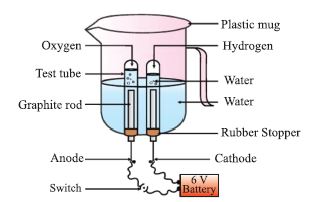
e.g., 2H2O   ==Electric current==>    2H2 + O2


e.g., 2AgCl (s)   ==Sunlight==>    2Ag (s) + Cl2 (g)

2AgBr (s)    ==Sunlight==> 2Ag (s) + Br2 (g)

* Above reaction is used in black & white photography.

• Endothermic Reactions : The reactions which require energy in the
form of heat, light or electricity to break reactants are called endothermic
reactions.

III. DISPLACEMENT REACTION : The chemical reaction in which more reactive element displaces less reactive element from its salt solution.


Fe (s) + CuSO4 (aq) → FeSO4 (aq) + Cu (s)


The iron nail becomes brownish in colour by deposition of Cu and blue colour of
CuSO4 changes dirty green colour due to formation of FeSO4.

Zn + CuSO4 → ZnSO4 + Cu

Zn is more reactive than copper.

IV. DOUBLE DISPLACEMENT REACTION : A reaction in which new compounds are formed by mutual exchange of ions between two compounds.

Na2SO4 (aq) + BaCl2 (aq) → BaSO4 (s) + 2NaCl (aq)
(Sodium          (Barium           (Barium         (Sodium

sulphate)          chloride)         sulphate)       chloride)

White precipitate of BaSO4 is formed, so it is also called precipitation reaction.

V. OXIDATION AND REDUCTION :

Oxidation :
i) The addition of oxygen to substance.

(ii) The removal of hydrogen from a substance.

C + O2 → CO2

2Cu + O2 ==Heat==>  2CuO

CuO + H2 ==Heat==> Cu + H2O

Reduction :
(i) The addition of hydrogen to substance.

(ii) The removal of oxygen from a substance.

OXIDATION AND REDUCTION

In this reaction CuO is reduced to Cu and H2 is oxidized to H2O. So, oxidation and  reduction taking place together is redox reaction.

=> Effects of Oxidation in Daily Life:

1) Corrosion :
• When a metal is exposed to substances such as moisture, acid etc. for some
time, a layer of hydrated oxide is formed which weakens the metal and hence
metal is said to be corrode

• Rusting of iron, black coating on silver and green coating on copper are
examples of corrosion.

• Corrosion can be prevented by galvanization, electroplating or painting.

2) Rancidity : The oxidation of fats and oils when exposed to air is known as
rancidity. It leads to bad smell and bad taste of food.

=> Methods to Prevent Rancidity :

(i) By adding antioxidants

(ii) Keeping food in air tight containers

(iii) Replacing air by nitrogen


(iv) Refrigeration.
Read More
    0

Online Notes on Chapter=1 ( Chemical Reactions and Equations) Part 1

Chemical Reactions and EquationsThis is Online Notes on Chapter=1 ( Chemical Reactions and Equations))  Part 1 for preparation of CBSE BOARD Examination, NTSE etc.


=> The process in which new substances with new properties are formed from
one or more substances is called Chemical Reaction.

* The substances which take part in chemical reaction are called Reactants.


* The substances which are formed in a chemical reaction are called Products.

Examples :
(i) Digestion of food
(ii) Respiration
(iii) Rusting of iron
(iv) Burning of Magnesium ribbon
(v) Formation of curd

=> Chemical reaction involves :
• Change in state
• Change in colour
• Change in temperature

• Evolution of gas

Ways of Representing a Chemical Reaction


=> Chemical Equation:

* A chemical reaction can be represented by chemical equation. It involves uses
of symbol of elements or chemical formula of reactant and product with
mention of physical state.

* The necessary conditions such as temperature, pressure or any catalyst should
be written on arrow between reactant and products.

e.g., Magnesium is burnt in air to form magnesium oxide.

Mg + O2 → MgO

=> Balancing Chemical Equation:

* Law of conservation of Mass. Matter can neither be created nor destroyed in a
chemical reaction.

* So number of elements involved in chemical reaction should remain same at
reactant and product side.

=>  STEPWISE BALANCING (Hit and Trial):

Step 1. Write a chemical equation and draw boxes around each formula.

Fe + H2O → Fe3O4 + H2

* Do not change anything inside the box.
Step 2. Count the number of atoms of each element on both the sides of chemical

equation.


Step 3. Equalise the number of atoms of element which has maximum number by putting in front of it.

Fe + 4H2O → Fe3O4 + H2

Step 4. Try to equalize all the atoms of elements on reactant and product side by
adding coefficient in front of it.

3Fe + 4H2O → Fe3O4 + 4H2

* Now all the atoms of elements are equal on both sides.

Step 5. Write the physical states of reactants and products.

3Fe (s) + 4H2O (g) → Fe3O4 ( s) + 4H2 (g)
Solid state = (s)
Liquid state = (l)
Gaseous state = (g)
Aqueous state = (aq)

Step 6. Write necessary conditions of temperature, pressure or catalyst on arrow

above or below.


Read More
    0

Online Notes on Chapter=5 ( Periodic Classificatoin of Elements) Part 2

This is Online Notes on Chapter=5 ( Periodic Classificatoin of Elements)  Part 2 for preparation of CBSE BOARD Examination, NTSE etc.


=> Modern Periodic Table:

• Atomic number of an element is a more fundamental property than its
atomic mass.

• According to the Modern Periodic law : The properties of elements are a
periodic function of their atomic number.


• All the anomalies of Mendeleev’s classification disappear.


Modern Periodic Table


=> Merits of Mendeleev’s Periodic Table:

(i) Some gaps were left for the undiscovered elements like gallium (Ga),
Scandium (Sc) and Germanium (Ge).

(ii) Predict properties of elements on the basis of their positions in the
periodic table.

(iii) Accommodate noble gases when they were discovered without
disturbing the original arrangement.

=> Limitations of Mendeleev’s Classification:

(i) Position of isotopes could not be explained.

(ii) No fixed position for hydrogen.

(iii) Wrong order of atomic masses of some elements could not be explained.

Explanation of the Anomalies :

(i) Explanation for the position of isotopes (Same atomic number put at one
place in the same group).

(ii) Cobalt with atomic number 27 came first and nickel (28) should come
later.

(iii) Unlike atomic masses, atomic number is always a whole number, so
there is no element between hydrogen and helium.

• Atomic Number : It is denoted by Z and equal to the number of protons
in the nucleus of an atom.

• Modern Periodic table has 18 vertical columns known as ‘groups’ and 7
horizontal rows known as ‘periods’.

• Elements with same number of valence electrons are placed in the same
group. For example,
Li : 2, 1 Na : 2, 8, 1 K : 2, 8, 8, 1

Outermost or valence shell in all the three contains 1 electron. These elements
have been placed in the same group.

• Number of shells increases as we go down the group.

• Elements with same number of occupied shells are placed in same period.
For example, Li (2, 1); Be (2, 2); B (2, 3), C (2, 4), N(2, 5). These
elements have same number of shells (two).

• Each period marks a new electronic shell getting filled.

• Number of elements placed in a particular period depends upon the fact
that how electrons are filled into various shell.


• Maximum number of electrons that can be filled in a shell is given by 2n2
where n is shell number.
E.g., K shell n = 1 or 2n2 = 2(1)2 = 2 First period has 2 elements.
L shell n = 2 or 2n2 = 2(2)2 = 8 Second period has 8 elements.

• Position of an element in the periodic table tells us its chemical reactivity.

• Valence electron determine the kind and number of bonds formed by the

element.

=> Trends in the Modern Periodic Table:

Valency : No. of valence electrons present in the outermost shell of its atom.
On moving from left to right in each period, the valency of elements increases

from 1 to 4 and then decreases to 0.

rends in the Modern Periodic Table


Metallic Character:

• Metallic character means the tendency of an atom to lose electron.

• Metals occupy the left hand side of the periodic table.

• On moving left to right in a period, the metallic character of an element
decreases because the effective nuclear charge increases. It means
tendency to lose electron decreases.

• Metals are electropositive as they tend to lose electrons while forming
bonds.

• Metallic character increases as we go down a group as the effective
nuclear charge is decreasing.
Non-metallic Character

• Non-metals are electronegative as they tend to form bonds by gaining
electrons.

• Non-metals occupies the right side of the periodic table.

• Non-metallic character increases across a period because due to increase
in effective nuclear charge that means tendency to gain electron increase.

• Non-metallic character decreases as we move down a group due to
decrease in effective nuclear charge experienced by the valence electron
thus the tendency to gain electron decreases.

• In the middle of periodic table we have semi-metals or metalloid because
they exhibit some properties of metals and non-metals.

• Oxides of metals are basic in nature while oxides of non-metals are acidic

in nature.


Metallic Character


Non-metallic Character


Read More
    0

Copyright (c) 2019 to 2020 - Chemistry Education Zone - All Right Reseved

© 2018 - 2020 Chemistry Education Zone. Designed by Bloggertheme9 | Distributed By Gooyaabi Templates
.
close